Investment Psychology · Wealth Building · 8 min read
Why the Harder You Work, the Less Wealth You Build
The counterintuitive truth from Poor Charlie's Almanack that most people completely miss — and the mental models that actually compound your financial decisions.
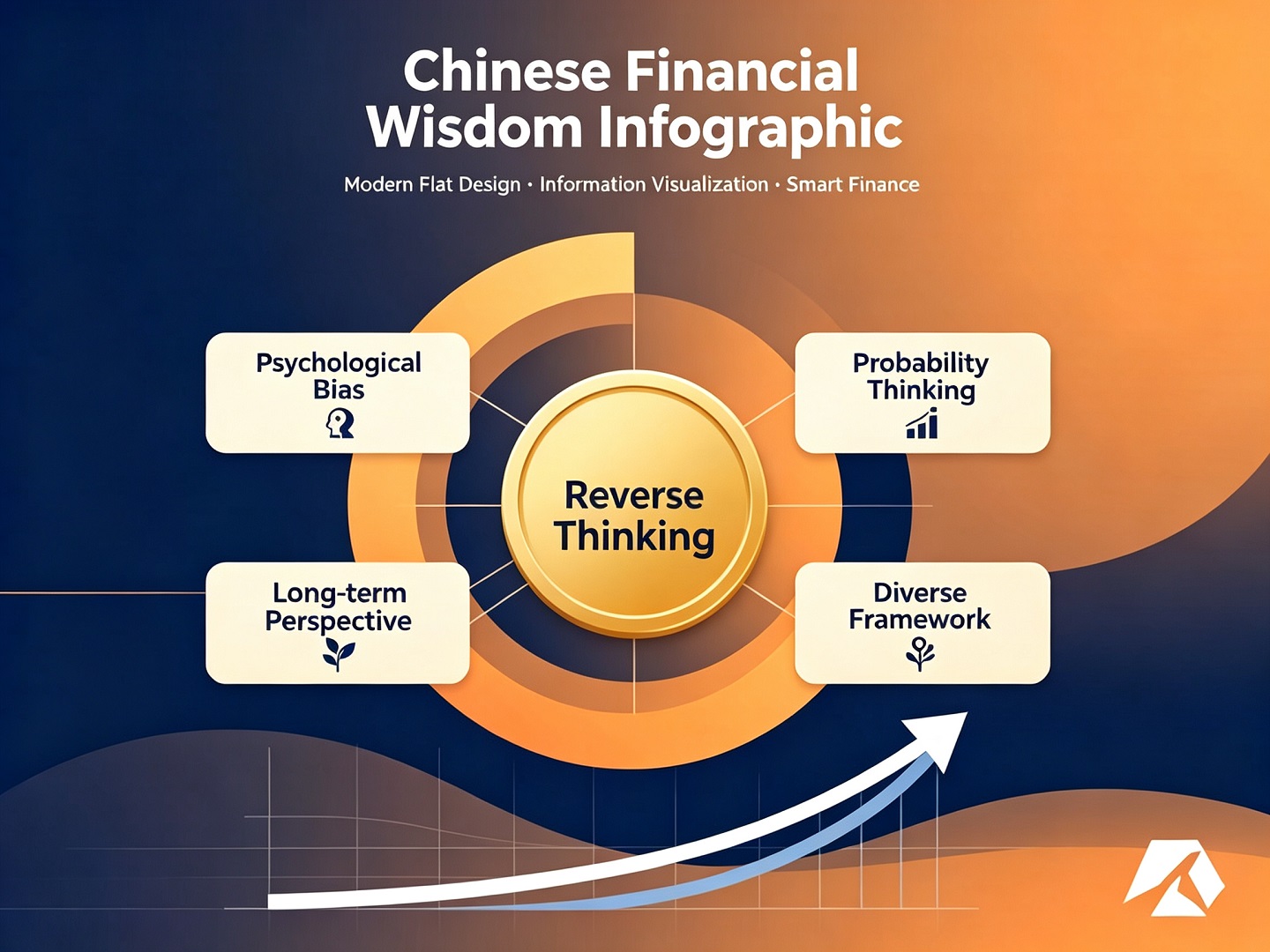
If you are between 25 and 45, chances are you have been stuck in this exact loop: you work hard, save aggressively, follow investment trends, and consume endless financial tips — only to watch your wealth stall, shrink, or get wiped out by a market correction.
Most people assume the problem is lack of information, opportunity, or effort. But after deep-diving into Poor Charlie's Almanack, the real issue becomes painfully clear: it is not that you are not trying hard enough — it is that your foundational decision-making framework is broken.
The One Truth Charlie Munger Taught the World's Best Investors
Charlie Munger spent decades distilling one core principle that separates consistent winners from perpetual underperformers:
“To succeed, first learn how to avoid failure. To make money, first learn how not to lose it.”
This inverse thinking approach flips the conventional "chase wins" model on its head. Instead of asking "What moves will make me rich?", you ask "What mistakes are most likely to destroy my wealth?" — and then systematically avoid them.
Munger put it bluntly: you do not need hundreds of winning investments. You only need four or five truly outstanding opportunities in your lifetime to build lasting wealth. The tragedy is that most people squander their capital, confidence, and time chasing the 95th opportunity while the right one sits quietly in front of them.
Three Universal Mental Traps That Drain Your Wealth — And How to Escape Each
Trap 1: Emotional Herding — “Everyone Else Is Doing It”
You see prices climbing. You feel the FOMO. You buy at the peak, convinced this time is different. Within months, you are holding a loss and waiting desperately for a recovery that may never come.
What Munger teaches: Build a personal decision checklist derived from multiple mental models across psychology, economics, and probability. Before any major financial move, run it through the “would I buy this if no one was watching?” test. Emotional distance is your most underrated asset.
Trap 2: Single-Point Career Growth — “Work Harder, Get Promoted”
You grind 60-hour weeks, deliver results, and wait for the promotion. Meanwhile, colleagues who understand systems thinking, influence dynamics, and multi-model problem solving leapfrog you while you stay stuck in horizontal repetition.
What Munger teaches: Adopt multi-model thinking. Rather than getting better at one thing, learn the basic frameworks from four or five different disciplines — psychology, accounting, engineering, biology. Cross-pollinating these models reveals opportunities invisible to specialists.
Trap 3: Decision-Making by Gut Feeling — “I’ll Just Go With My Instinct”
You feel confident. You move fast. You commit large sums based on a tip, a news headline, or a social media post — and then watch your savings get handed over to statistical uncertainty.
What Munger teaches: Twenty-five types of human misjudgment systematically destroy wealth — from availability bias to overconfidence effect to loss aversion. The solution is not more information, but a structured latticework of mental models that filters bad decisions before they happen.
What Poor Charlie's Almanack Actually Teaches — Beyond the Bookstore Summary
Most people read the book and extract three or four inspiring quotes. They miss the architectural framework that makes Munger’s thinking so powerful. Here is what actually compounds:
- Inverse thinking: Ask “What would guarantee failure?” — then ruthlessly avoid those paths, regardless of how attractive they look in the moment.
- Multi-disciplinary latticework: No single field has the complete answer. The best decisions emerge from layering models from psychology, economics, physics, biology, and engineering.
- Margin of safety: Only invest when the downside is bounded and the upside is asymmetrically large. Most people do the exact opposite.
- Patience as a strategy: Compounding requires time. Time requires saying no to 95% of opportunities. Munger has said no to thousands of bad deals — that is precisely why his track record is legendary.
The real takeaway: the gap between people who build lasting wealth and those who do not is not intelligence or luck — it is a stable, correct, and repeatable decision-making system.
Your Three-Step Munger Framework for Better Financial Decisions
- Identify the failure modes first. Before any investment or major career decision, write down the three most likely ways this could go wrong. Use at least two different mental models.
- Stress-test with inverse thinking. Ask: “If this were the worst possible decision I could make right now, what would it look like?” — and check if your current plan resembles it.
- Apply the 24-hour rule. For any decision involving more than 10% of your liquid assets, wait 24 hours. Sleep on it. Distance erases emotion and reveals clarity.
The full checklist of 25 human misjudgments, the multi-model thinking cheat sheet, and the step-by-step investment decision framework are available in the complete Poor Charlie’s Almanack breakdown guide.
Get the Free Framework Guide →No spam. No upsells. Just the framework.