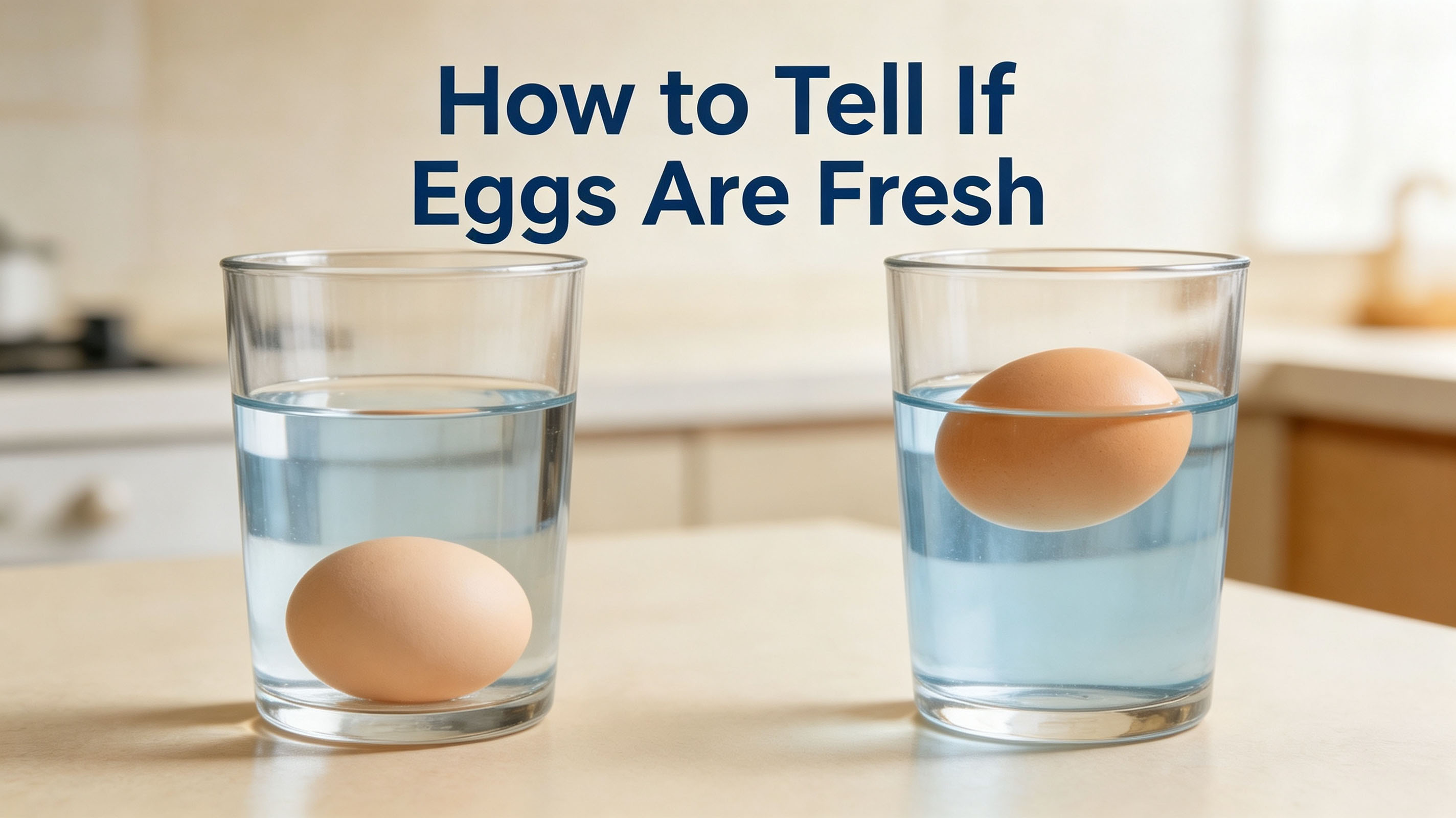
Ever wonder whether the eggs in your fridge are still good to eat? You don't need fancy equipment or a food lab — a glass of water can tell you in about 30 seconds. The egg water test (also called the float test) is one of the oldest, easiest kitchen tricks for checking egg freshness. Here's how to do it, what each result means, and when a floating egg is a red flag.
Why the Water Test Works
Eggshells look solid, but they're actually covered in thousands of microscopic pores. As an egg ages, moisture and carbon dioxide escape through those pores, and air slowly seeps in to replace them. This growing pocket of air — called the air cell — makes older eggs more buoyant.
- A brand-new egg has a tiny air cell, so it sinks and lies flat on the bottom of the glass.
- As the air cell grows, the egg becomes less dense and starts to tilt, then stand upright, and finally float.
That's the whole science behind the test: fresher eggs sink, older eggs float.
How to Do the Water Test (Step by Step)
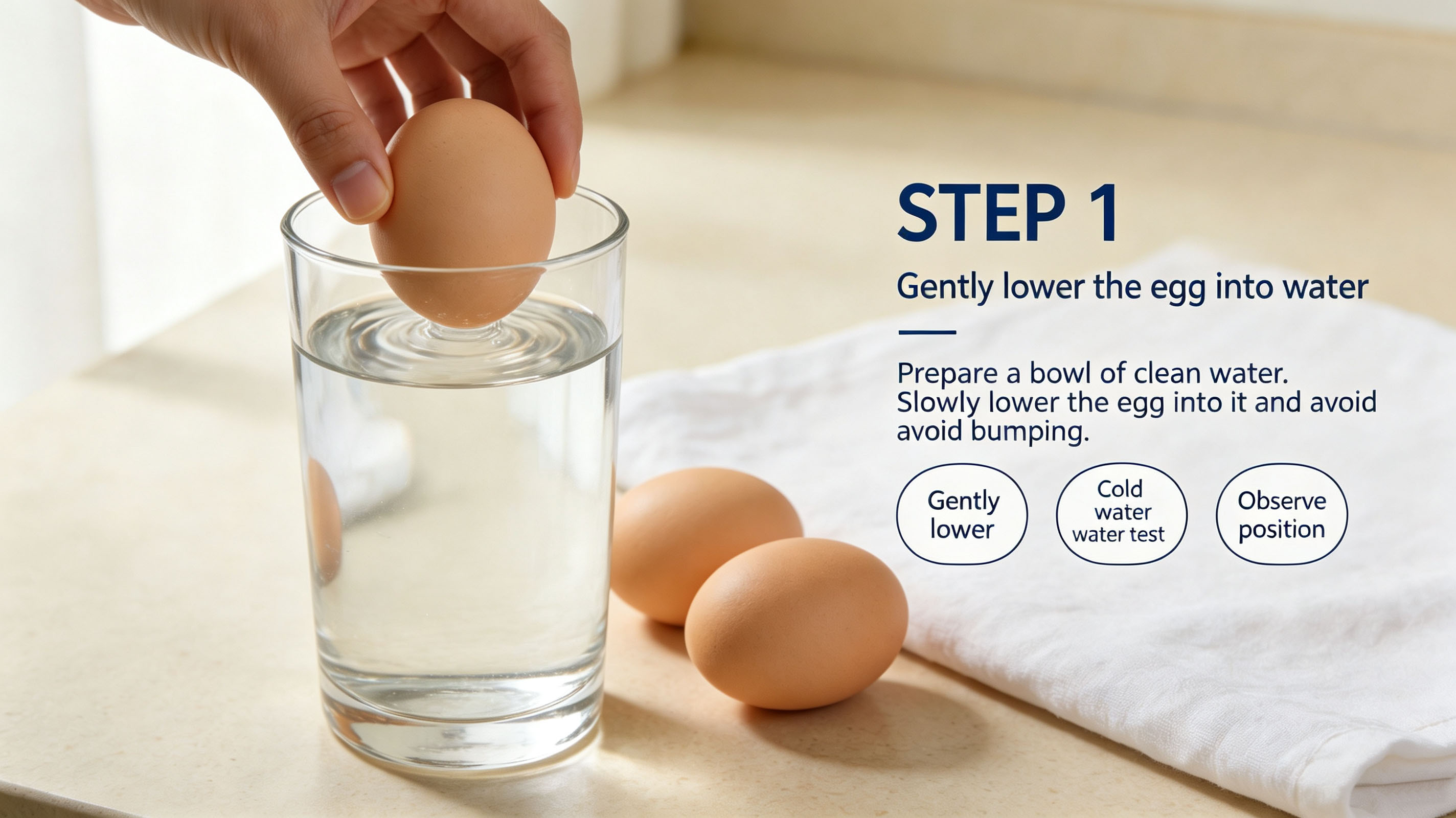
- Fill a bowl or glass with cold water — deep enough to fully cover the egg. (Cold water matters: warm water can make a borderline egg rise or even crack the shell.)
- Gently lower the egg into the water with a spoon so it doesn't crack on the bottom.
- Watch the egg for a few seconds. Its position tells you exactly how fresh it is.
What Each Result Means
| Egg position | What it means | What to do |
|---|---|---|
| Lies flat on the bottom | Very fresh — a few days old | Eat it any way you like: fried, poached, soft-boiled, even raw in dressings |
| Tilts up at an angle | A few weeks old | Perfectly fine; use within a few days |
| Stands upright on the bottom | Older, but usually still safe | Use only in fully cooked dishes (baking, hard-boiling) |
| Floats to the surface | Likely spoiled | Do not eat — throw it out |
Is a Floating Egg Always Bad?
Nearly always. As an egg spoils, bacteria produce gas that inflates the air cell and pushes the egg upward. That said, the float test isn't 100% proof: an extremely old egg that hasn't spoiled can float too. The safe rule of thumb: when in doubt, throw it out. And after you crack any egg, let your nose make the final call — a fresh egg has almost no odor, while a spoiled one smells strongly of sulfur.
4 More Quick Freshness Checks
- The sniff test. Crack the egg into a clean bowl. No smell = fine. A rotten, sulfuric smell = toss it.
- The shake test. Hold the egg to your ear and shake gently. Fresh eggs feel solid and quiet; older eggs slosh noticeably.
- The candling test. In a dark room, hold a bright flashlight against the shell. A small air cell and clear, firm white mean fresh; a large, dark air cell means old.
- Check the date code. Look for the "best before" date (common in the EU) or the Julian pack date on the carton (common in the US). Properly refrigerated eggs generally stay good 3–5 weeks from the pack date.
How to Store Eggs to Keep Them Fresh
- Keep them refrigerated at a steady temperature below 40°F (4°C). Note: in many European countries eggs are sold at room temperature — but once you refrigerate them, keep them refrigerated to avoid condensation on the shell.
- Store eggs in their original carton, not in the fridge door, where temperatures swing every time it opens.
- Keep them away from strong-smelling foods — the shell is porous and eggs absorb odors.
- Never wash eggs before storing; the protective coating on the shell helps keep bacteria out.
- Discard cracked or leaking eggs — bacteria can enter through the shell.
Egg Freshness FAQ
Can you eat an egg that floats?
No. Floating usually means the egg is spoiled, so discard it to be safe.
How accurate is the water test?
It's a reliable general indicator of egg age and freshness, but always follow up with the sniff test once you crack the egg.
How long do eggs last in the fridge?
About 3–5 weeks from the pack date when stored properly under refrigeration.
Why does an older egg stand upright in water?
The air cell at the blunt end grows larger and more buoyant, lifting that end of the egg so it tilts or stands upright.
The Bottom Line
The water test is fast, free, and remarkably reliable: sinks flat = fresh, tilts = use soon, floats = toss it. Pair it with a quick sniff and a glance at the date code, and you'll never have to guess about an egg again.